


Kids Dental Insurance Coverage: 2026 Parent Guide

The best surprise after your child's dental visit should be a shiny sticker and a proud, glowing smile, not an unexpected bill in your mailbox. If you feel tangled in confusing terms like deductibles, coinsurance, and arbitrary age limits on dental sealants, you're definitely not alone. Every parent wants gentle, high-quality care that keeps their little explorer smiling, yet wondering whether specialized pediatric options like nitrous oxide are covered often brings unwelcome stress. Knowing the right kids dental insurance coverage questions to ask before you schedule your visit changes the entire experience.
You shouldn't have to decode complicated policy booklets just to protect your family's budget. In this 2026 guide, you'll discover the exact questions to ask your insurer so you can unlock every available benefit and prevent out-of-pocket surprises. We'll walk you through how to organize your child's oral health into preventive checkups, restorative care, and comfort needs so you can embrace every dental milestone with complete confidence.
Table of Contents
Understanding Pediatric Dental Coverage: Essential Benefits and Policy Basics
Growing smiles follow their own unique roadmap. Pediatric dental insurance is designed specifically to champion this continuous journey, protecting developing teeth from infancy all the way through adolescence. Because a child's mouth transforms rapidly as baby teeth make way for permanent ones, pediatric coverage operates under distinct guidelines compared to adult policies. Understanding how your plan is structured helps ensure your little one receives thoughtful, timely care while protecting you from unexpected expenses.
The ACA Pediatric Dental Mandate and Essential Health Benefits
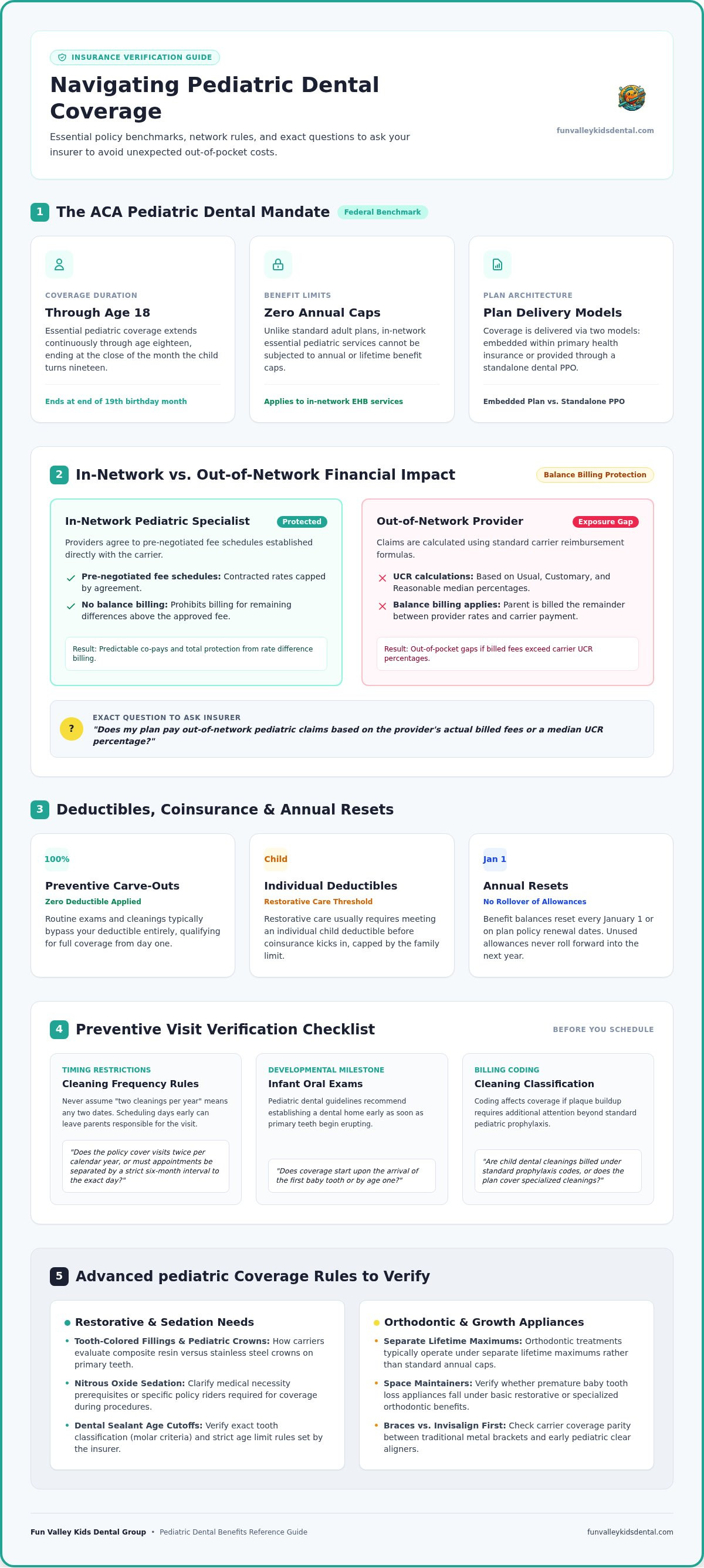
Under the Affordable Care Act, pediatric dental care is classified as an Essential Health Benefit (EHB) for children through age eighteen, ending at the close of the month they turn nineteen. Unlike adult plans, in-network essential pediatric services cannot be subjected to annual or lifetime benefit caps. However, coverage can arrive in two distinct ways: embedded within your primary health insurance or via a standalone dental PPO. Familiarizing yourself with dental insurance plan models and cost structures helps clarify whether your child's dental claims apply to a separate, smaller dental deductible or your family's larger medical deductible.
In-Network vs. Out-of-Network Pediatric Providers
Partnering with an in-network pediatric specialist creates a protective financial haven for your family. Contracted providers agree to pre-negotiated fee schedules, which prevents balance billing, the practice where an office bills you for the remainder between their standard rates and insurer payments. Out-of-network claims rely on usual, customary, and reasonable (UCR) calculations, often leaving parents with unexpected out-of-pocket gaps. When calling your carrier with kids dental insurance coverage questions, ask: "Does my plan pay out-of-network pediatric claims based on the provider's actual billed fees or a median UCR percentage?"
Deductibles, Annual Maximums, and Calendar Year Resets
Financial mechanics vary widely between routine upkeep and advanced restorations. Knowing how these moving parts interact ensures smoother visits:
Preventive Care Carve-Outs: Routine exams and cleanings typically bypass your deductible entirely, qualifying for full coverage from day one.
Individual Deductibles: Restorative work usually requires meeting an individual child deductible before coinsurance kicks in, capped by your total family threshold.
Annual Resets: For plans with annual maximum limitations, benefit balances reset every January 1 or on your plan's specific policy renewal date. Unused allowances do not roll forward.
Asking targeted kids dental insurance coverage questions early allows you to schedule essential milestones smoothly, keeping both your child's smile and your family budget beautifully balanced.
Essential Questions to Ask Your Insurer About Preventive Pediatric Care
Preventive appointments lay the foundation for a lifetime of bright, cavity-free smiles. While most family plans cover routine diagnostic checkups at 100%, hidden policy rules can trigger unexpected bills. Having a targeted checklist of kids dental insurance coverage questions ready before you call member services ensures your child receives complete preventive protection without administrative surprises.
Exam and Cleaning Frequency Rules and Timeframes
Never assume "two cleanings per year" means any two dates you pick. Insurers enforce precise timing restrictions that can leave parents responsible for an entire visit if scheduled even a few days early. When clarifying guidelines with your representative, ask these direct questions:
The Timing Rule: Does the policy cover visits twice per calendar year, or must appointments be separated by a strict six-month interval to the exact day?
Infant Oral Exams: Does coverage start upon the arrival of the first baby tooth or by age one, aligning with early developmental guidance from a trusted pediatric dentist in Sun Valley, CA?
Cleaning Classification: Are child dental cleanings billed under standard prophylaxis codes, or does the plan cover specialized cleanings if plaque buildup requires extra attention?
Fluoride Treatments and Sealant Eligibility Questions
Preventive shields like topical fluoride varnish and dental sealants stop decay before it starts, but carriers often enforce narrow age cutoffs. Under the Affordable Care Act pediatric dental essential health benefits, plans must offer core preventive safeguards, though specific limitations vary by policy. Ask your insurer:
Fluoride Age Limits: Up to what age are professional in-office fluoride treatments covered, and is the benefit limited to once or twice annually?
Tooth Eligibility: Are protective dental sealants restricted exclusively to permanent first and second molars, or are premolars and primary molars eligible?
Repair and Replacement: If a sealant experiences natural wear within two to three policy years, does the plan cover reapplication?
Diagnostic X-Rays and Frequency Allowances
Radiographs give pediatric specialists an internal map of erupting teeth and hidden decay between tight contacts. However, diagnostic limits are strict. Verify whether routine bitewing radiographs are limited to once every twelve months or once every six months for high-risk children. Confirm how frequently panoramic images are approved to monitor dental development, and verify whether emergency dental care evaluations use separate diagnostic allowances rather than exhausting your child's annual preventive imaging limits.
If you would like experienced guidance sorting through policy details before your next visit, the friendly team at Fun Valley Kids Dental Group is always happy to help verify your preventive benefits ahead of time.
Coverage Questions for Restorative Care and Pediatric Sedation
Even with diligent brushing, small bumps along the trail happen. Restorative care repairs early childhood decay, physical play injuries, and developmental enamel conditions so baby teeth can guide permanent teeth into place properly. However, while preventive visits enjoy straightforward tiering, restorative care triggers varying coinsurance splits, deductible requirements, and policy nuances. Understanding these benefit mechanics helps you protect your child's comfort without facing unbudgeted costs.
Tooth-Colored Fillings and Alternate Benefit Clauses
Modern pediatric dentistry prioritizes natural-looking aesthetics using composite resin. Many commercial policies, however, enforce an "alternate benefit clause" for back molars. This means the insurer pays reimbursement rates for traditional silver amalgam and passes the difference along to you. As highlighted by pediatric dental health and preventive treatment guidelines, prompt intervention stops decay from reaching inner nerve tissues. When preparing kids dental insurance coverage questions for your representative, ask:
Material Downgrades: Does the policy cover tooth-colored fillings on posterior primary molars at full composite tiering, or is payment reduced to amalgam rates?
Deductible Application: Does our individual child deductible apply before the plan begins paying its coinsurance share for fillings?
Multi-Surface Rules: Does coverage vary based on the number of tooth surfaces repaired in a single appointment?
Pediatric Dental Crowns and Pulpotomy Inquiries
When decay reaches the nerve of a primary tooth, a gentle nerve treatment called a pulpotomy helps preserve it. A protective crown follows to keep the structure intact until natural exfoliation. Knowing your plan's classification for these services prevents confusion. While some plans group pulpotomies under basic restorative care, others categorize them as major services with higher copay percentages. For sudden sports injuries or broken teeth, partnering with a dependable emergency dentist for children in Sun Valley ensures prompt repair, but you should also verify:
Crown Aesthetics: Are pediatric tooth-colored dental crowns reimbursed equally alongside traditional stainless steel caps?
Pre-Authorization Protocols: Does your carrier require radiographic review or narrative submissions before authorizing multi-tooth restorations?
Nitrous Oxide Sedation and Comfort Dentistry Coverage
Helping a nervous explorer relax during restorative appointments transforms medical anxiety into a peaceful milestone. Mild relaxation support via nitrous oxide sedation calms sensitive nerves, yet insurance policies frequently classify it as an elective comfort option. Some plans cover it only under specific medical exemptions or young age thresholds. Exploring compassionate options through pediatric sedation dentistry in Sun Valley, CA helps children remain completely comfortable. When reviewing policy terms, ask your carrier whether your employer plan includes a comfort rider for nitrous oxide or if pre-treatment medical documentation is required.
Navigating Orthodontic Benefits: Braces, Space Maintainers, and Aligners
Watching your child's permanent smile take shape is an exciting adventure, but aligning teeth and guiding jaw growth follows completely different insurance rules than routine dental care. Orthodontic benefits function independently from annual preventive policies. Asking targeted kids dental insurance coverage questions early ensures you understand your financial roadmap before treatment begins.
Lifetime Orthodontic Maximums and Age Limitations
Unlike standard dental benefits that reset every January, orthodontic coverage usually operates under a separate lifetime maximum. This lifetime pool applies once per child and never refreshes. When speaking with your insurance representative, clarify these fundamental details:
The Lifetime Cap: Does your family plan include an active orthodontic rider, and what is the total lifetime maximum benefit available for each dependent?
Age Cutoffs: Does coverage require appliance placement before a specific age milestone, such as the child's nineteenth birthday?
Disbursement Schedules: Does the insurer distribute payments in quarterly increments throughout active care or as an initial lump-sum reimbursement?
Space Maintainers and Interceptive Orthodontic Coverage
When a primary tooth departs early due to injury or deep decay, a space maintainer keeps the open path safe for the permanent tooth underneath. Carriers handle these small holding appliances in different ways. Some group them with Class I preventive services, while others categorize them as Class II basic restorations. Inquire whether space maintainers deplete your child's lifetime orthodontic maximum or apply to standard dental benefits. Partnering with a dedicated kids orthodontist in 91352 helps monitor dental development closely while keeping treatment classifications clear.
Traditional Braces vs. Invisalign First Clear Aligners
Modern smile correction offers wonderful choices, including durable traditional braces and gentle Invisalign First clear aligners designed specifically for growing jaws. Most modern commercial plans now apply the same orthodontic allowance to clear aligners that they extend to metal brackets. However, insurers almost always require clinical documentation, such as diagnostic photographs and bite records, before approving treatment. Determining what portion the carrier pays toward your selected option lets you calculate remaining family expenses without guesswork.
Ready to chart a smooth path for your child's smile journey? Schedule an early orthodontic consultation with our caring team to review your alignment options and confirm your family's coverage details today.
Guide to Verifying Benefits at Fun Valley Kids Dental
Sorting through policy documents shouldn't feel like a confusing chore. Checking insurance details should be a reassuring partnership where you feel fully supported every step of the way. When our dedicated clinical and front-office team collaborates with you early, unexpected costs disappear. Taking a proactive approach allows your family to focus entirely on your child's comfort, curiosity, and glowing smile.
Gathering Your Insurance Card and Policy Details
A stress-free visit starts with having key documentation ready before picking up the phone. When preparing your kids dental insurance coverage questions, locate these essential items:
Core Member Data: Find the subscriber's full name, member ID number, child dependent ID, and group policy number.
Carrier Contact Information: Note the electronic payer ID, primary dental claims mailing address, and dedicated customer service phone line on the back of your card.
Renewal Cycle: Confirm whether your plan operates on a standard January-to-December calendar year or follows a distinct employer plan year.
Requesting a Complimentary Pre-Treatment Estimate
Guesswork has no place in healthcare budgeting. If your child needs multi-surface care, space maintainers, or restorative work, requesting a formal pre-treatment estimate brings total financial clarity. Our clinical team submits diagnostic digital radiographs alongside clear narrative notes directly to your payer. The insurer then responds with a formal pre-determination breakdown detailing approved procedure codes, contracted payer payments, and your exact family copayment portion. This transparent, community-centered approach defines our mission at Fun Valley Kids Dental Group, where parents enjoy complete peace of mind before care begins.
Maximizing Benefits and Coordinating Year-End Visits
Timing your appointments thoughtfully ensures you use every earned benefit dollar before it disappears. Most policy maximums expire at year's end without carrying over, making autumn the ideal season to complete recommended pediatric dental exams, cleanings, or preventive sealants. If extensive treatment requires multiple phases, our administrative coordinators can help stage appointments across consecutive benefit quarters or calendar years, maximizing insurance contributions. Asking your carrier the right kids dental insurance coverage questions beforehand empowers you to protect your family's budget while giving your child a joyful dental home.
Chart a Confident Path for Your Child's Healthy Smile
Deciphering dental benefits shouldn't cloud the joy of your child's oral health milestones. By organizing appointments into preventive care, gentle restorative treatments, and developmental orthodontic growth, you can navigate policy guidelines with total clarity. Having the right kids dental insurance coverage questions ready protects your family budget against surprises and alternate benefit clauses, letting you keep your focus where it belongs: on your little adventurer's happy smile.
At Fun Valley Kids Dental Group, our dedicated pediatric dental specialists love serving families throughout Sun Valley and the greater San Fernando Valley. Inside our whimsical, child-friendly clinic designed for anxiety-free smile adventures, we prioritize gentle comfort and complete financial transparency. We handle the paperwork details, providing upfront insurance verification and complimentary pre-treatment cost estimates so you can plan care with ease. Connect with our friendly Sun Valley team to verify your child’s dental insurance benefits today!
Frequently Asked Questions
Does pediatric dental insurance cover dental sealants on baby teeth?
Most commercial plans limit dental sealants strictly to permanent first and second molars, usually excluding primary baby teeth. While sealants offer excellent cavity protection on deep grooves, insurers rarely consider them essential on baby teeth unless high-risk factors exist. Contacting your carrier with targeted kids dental insurance coverage questions helps determine if your policy makes exceptions for vulnerable primary molars.
Why did my insurance company downgrade my child’s white filling?
Insurers often apply an alternate benefit clause when composite tooth-colored fillings are placed on back molars. Under this contractual rule, the insurance provider calculates payment using the lower fee for traditional silver amalgam. The policyholder remains responsible for paying the cost difference between the two materials. You can ask your carrier whether your specific policy plan covers tooth-colored resin on posterior teeth at standard coinsurance percentages.
Is nitrous oxide sedation covered by dental insurance for kids?
Standard dental plans frequently classify nitrous oxide sedation as a non-covered comfort service rather than a clinical necessity. Coverage generally requires a dedicated employer benefit rider or clinical documentation demonstrating special healthcare needs. Families in Burbank and Sun Valley can ask their pediatric provider to submit a pre-treatment narrative showing why gentle inhalation relaxation is necessary to ensure safe, distress-free restorative treatment.
What is a pre-treatment estimate and should I request one?
A pre-treatment estimate is a formal preview where your pediatric dentist submits proposed treatment codes and diagnostic digital radiographs to your insurer before scheduling procedures. The carrier sends back an itemized statement detailing approved benefit contributions, policy limits, and your estimated out-of-pocket balance. Requesting one before major restorative or orthodontic care eliminates financial surprises and allows you to budget with total confidence.
Does my medical insurance ever cover pediatric dental procedures?
Medical insurance plans occasionally cover pediatric dental care when treatment stems from acute physical facial trauma, congenital abnormalities, or medically complex conditions. If a child suffers a sports collision or requires hospital-based care due to underlying medical diagnoses, medical claims may apply. Routine dental decay, standard tooth extractions, and basic childhood restorations must always be submitted through your primary dental insurance policy.
How often will my insurance plan pay for children’s dental x-rays?
Coverage intervals for pediatric diagnostic imaging depend on the type of radiograph taken. Routine bitewing films are typically covered once every twelve months, or once every six months for children with elevated decay risks. Comprehensive panoramic images and full-mouth surveys are usually limited to once every three to five years, though emergency dental care evaluations often use separate allowances.
What happens if my child loses a tooth early and needs a space maintainer?
Insurance plans generally categorize space maintainers as Class II basic restorations, though select policies group them under Class I preventive benefits. Coverage is commonly restricted to the premature loss of primary posterior molars in children under age sixteen. When reviewing kids dental insurance coverage questions with your carrier, confirm whether your plan allows replacement appliances if a fixed space maintainer becomes damaged or lost.


Comments