


Explaining Dental Procedures to a Child: A Calm, Age-Appropriate Guide

What if the most reassuring thing you can tell your child isn’t “it won’t hurt,” but “I’ll help you understand what happens next”? Explaining dental procedures to a child can feel tricky when you want to ease their worries without promising exactly how a visit will feel. A little honesty, shared in simple steps, can help your child feel prepared without giving them more detail than they need.
It’s natural to wonder what to say, when to say it, and how to answer questions you may not know how to handle. A calm, brief preview can explain what may happen while leaving room for the dental team to describe the specific steps at the appointment. Each child and treatment is different, so reassurance doesn’t mean predicting every moment.
In this guide, you’ll find age-appropriate ways to describe dental care, respond to common questions, and help your child feel included. We’ll also look at how a pediatric dental team can use clear explanations and a child-friendly setting to support the visit. Fun Valley Kids Dental Group provides pediatric dental and orthodontic care at its Sun Valley office for families in Sun Valley, Pacoima, Arleta, Panorama City, North Hollywood, Burbank, and Sylmar.
Table of Contents
Explaining dental procedures to a child starts with trust
A child may feel curious, nervous, or unsure about a dental visit, especially if they’ve heard unfamiliar words or had a difficult experience before. Begin by letting them know their feelings make sense. Instead of saying, “There’s nothing to worry about,” try, “I can see you have questions. Let’s talk about what you know.” This shows your child they can be honest with you.
A dental procedure is a step the dental team may recommend to care for teeth or gums. It might be an exam, a cleaning, or another type of care. The dentist first assesses your child’s needs, then explains the recommended care and why it may help. Since the plan depends on that individual assessment, avoid describing a treatment as certain before the dental team has discussed it with you.
A child-friendly explanation is honest, brief, and suited to the child, with room for questions as the next step becomes clearer. This helps you share enough to build trust without trying to predict every detail of the visit. Pediatric dentistry focuses on children’s oral health, but your child’s dentist can explain which specific steps apply to their needs.
Start with what your child already knows
Before offering a preview, ask, “What have you heard about the appointment?” Their answer may show whether they’re picturing a routine check or worrying about something specific. Listen without correcting them right away, then answer the question they asked using familiar, accurate words. For example: “The dentist will look at your teeth and tell us what they see.” Explain a clinical term if it comes up or helps make the plan clearer.
Be reassuring without making promises
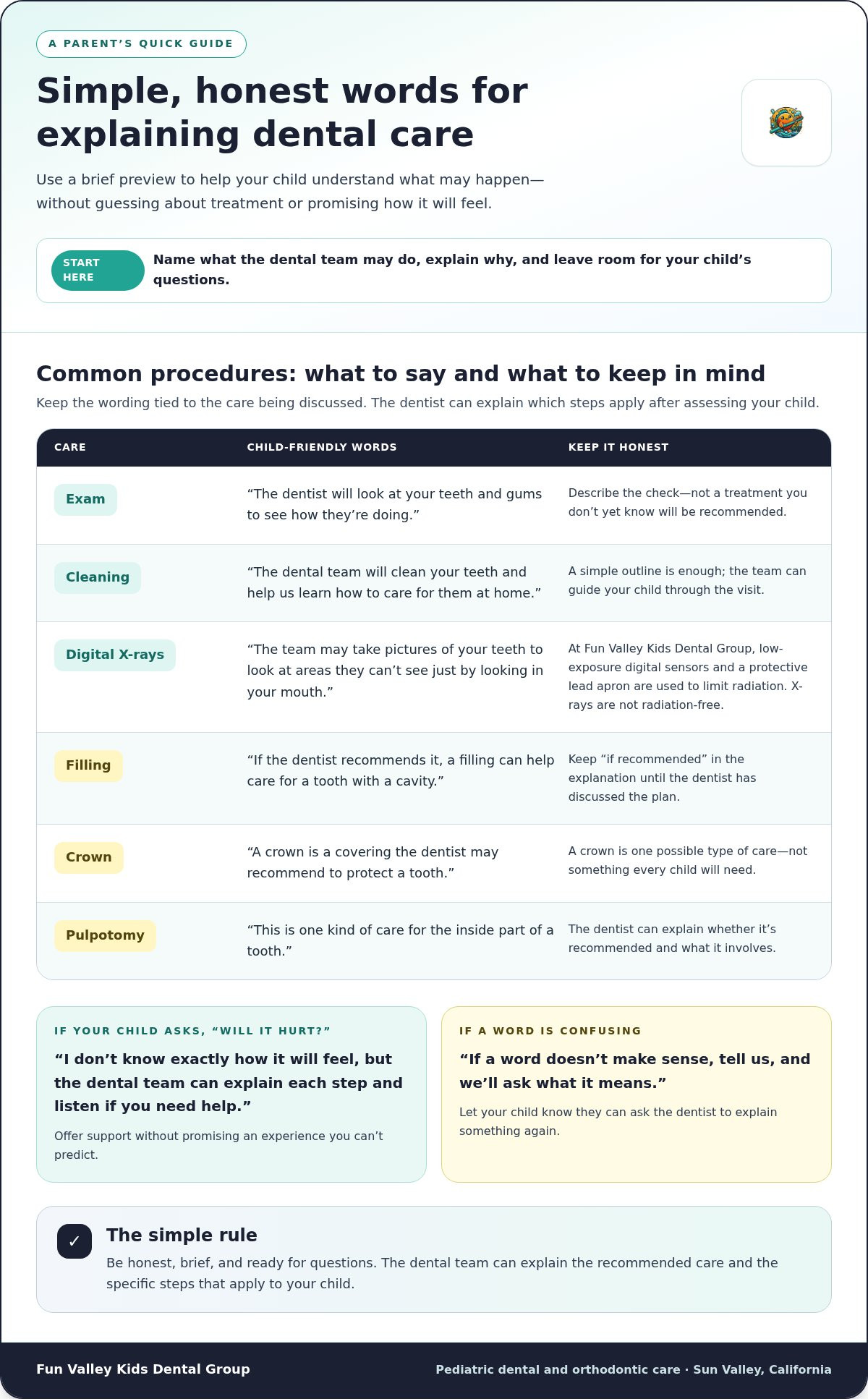
It’s tempting to promise that treatment won’t hurt or that your child won’t feel anything. But you may not know exactly how the experience will feel, and a promise that doesn’t match the visit can make it harder to build trust next time. Try: “I don’t know exactly how it will feel, but the dental team can explain each step and listen if you need help.” This offers support without claiming certainty.
Let your child know it’s okay to ask the dentist to explain something again. You might say, “If a word doesn’t make sense, tell us, and we’ll ask what it means.” That gives your child a way to speak up without needing all the right words. When explaining dental procedures to a child, your role isn’t to give a clinical lesson. It’s to help them feel heard while the dental team explains the recommended care.
How to explain common dental procedures in child-friendly language
Helpful explanations name what the dental team is doing and why, without turning the conversation into a clinical lesson. Keep your preview tied to the appointment your child is having. You might say, “The dentist will check your teeth and tell us what they notice,” rather than guessing what treatment may be needed. After examining your child, the dentist can explain the recommended care and help you find simple, accurate words to describe it.
Preview exams, cleanings, and digital X-rays
For an exam, try: “The dentist will look at your teeth and gums to see how they’re doing.” For a cleaning, you could say: “The dental team will clean your teeth and help us learn how to care for them at home.” Use literal words your child can picture. The team can guide your child through the visit, so you don’t need to explain every tool or sensation in advance.
If digital X-rays are part of the visit, you could say, “The team may take pictures of your teeth to look at areas they can’t see just by looking in your mouth.” At Fun Valley Kids Dental Group, X-rays are performed with low-exposure digital sensors and a protective lead apron to limit radiation. Don’t describe them as radiation-free. The American Academy of Pediatric Dentistry (AAPD) resources for parents can also help families find information about children’s oral health.
Talk about treatment only as specifically as you know
Fillings, crowns, and pulpotomies are examples of care a dentist may discuss, not treatments every child will need. The dentist recommends care after examining the child and considering their individual needs. Until then, avoid telling your child that a particular treatment is definitely planned or predicting how it will feel, how long it will take, or what the result will be.
Filling: “If the dentist recommends it, a filling can help care for a tooth with a cavity.”
Crown: “A crown is a covering the dentist may recommend to protect a tooth.”
Pulpotomy: “This is one kind of care for the inside part of a tooth. The dentist can explain whether it’s recommended and what it involves.”
These short previews offer a starting point, not a promise about the treatment plan. If your child asks, “Will it hurt?” avoid guessing. You can say, “I’m not sure exactly how it will feel, but we can ask the dentist to explain what to expect and how they’ll help you.” Families can discuss their child’s needs with the pediatric dental team at Fun Valley Kids Dental Group in Sun Valley.
Choose an explanation that fits your child's age and needs
Children don’t all need the same preview, even if they’re the same age or have a similar appointment. One child may feel ready after hearing a simple outline; another may want more detail or time to ask questions. There’s no perfect script. Offer information your child can use, then notice whether they seem ready to hear more or would rather pause.
The explanation each child needs depends on their dental needs, development, questions, and preferences. Age can help you choose words, but it doesn’t predict exactly how a child will feel or what they’ll want to know. Let your child’s responses guide the conversation instead of treating a birthday as a readiness test.
Adapt the level of detail to the child's understanding
For a younger child, try one short idea at a time: “The dentist will look at your teeth, then tell us what comes next.” Pause to see what they ask. Older children and teens may appreciate a fuller explanation and time to talk through their questions. After explaining, check their understanding with, “What do you think will happen?” This can help you spot confusion without putting them on the spot to agree.
More detail isn’t always more helpful. A long preview can introduce unfamiliar words or possibilities your child wasn’t wondering about, while a vague answer can leave them unsure what to expect. Share the main idea first, then add information in response to their questions. If you don’t know an answer, say so and make a note to ask the dental team together.
Make room for sensory sensitivities and worry
A child may find a sound, taste, bright light, or unfamiliar setting challenging without knowing how to explain why. Ask gently, “Is there a part you’re wondering about?” or offer a choice: “Would you like to tell me, or should we ask the dentist together?” If they don’t want to answer, don’t press. Share relevant sensory or communication needs with the dental team before care so they can take that information into account.
Describe what you’ve observed without assuming what will solve it. For instance, tell the team if your child prefers extra time to process information. They can discuss how to communicate about the visit without promising exactly how your child will respond. Special needs kids are welcome. A supportive approach starts with listening to the child and family, then adapting explanations to the individual rather than expecting every child to cope in the same way.
As you prepare, consider what helps your child understand information in other settings: a short verbal preview, a chance to ask questions, or time to think before responding. These observations can give the dental team useful context. Your child doesn’t need to explain everything perfectly. Even a small clue about what feels difficult can help guide a more thoughtful conversation.
Prepare your child for a dental procedure before the appointment
A short, thoughtful plan can help your child know what to expect without making the visit feel like a mystery. Start with the dental team’s explanation of the recommended care. Then share the main points simply, make room for questions, and remind your child they can ask for help understanding something. This approach works for a first visit and for a procedure your child hasn’t experienced before.
Before the visit, make a simple plan together
Once you understand the plan, talk about it close enough to the appointment that your child can remember the main points. Keep your preview brief and accurate. Ask, “What would you like to know about the visit?” If a question needs a clinical answer, write it down for the dental team rather than guessing. Share your child’s concerns, communication preferences, or sensory needs with the team before care.
Use this simple order to prepare:
Learn the plan. Get the procedure-specific details from the dental team, including what care is recommended and how they’ll explain it to your child.
Talk together. Give your child a clear, age-appropriate preview, then pause to hear their thoughts.
Prepare questions. Keep a short list so you and your child can ask about anything that still feels unclear.
Follow up. After the appointment, check in about what your child noticed and what they’d like to understand next time.
A comfort item, such as a small familiar toy, may reassure some children. Bring one if it suits your child and the visit arrangements, and ask the dental team how to handle it during care. Avoid rehearsing alarming details or presenting the appointment as a threat, such as “If you don’t brush, you’ll need a filling.” Dental care is not a punishment, and using it as one can add worry to an unfamiliar experience.
During and after the visit, keep communication open
At the appointment, let the dental team explain each next step rather than narrating unfamiliar clinical details yourself. You can stay close, listen, and offer calm encouragement, such as, “You’re doing your best to tell us what you need.” Try not to judge your child’s reaction as good or bad. They may feel unsure, need a pause, or have questions. Those responses are useful information for the team.
Afterward, invite a low-pressure conversation: “What did you learn?” or “Is there anything you still wonder about?” Listen first, without correcting every detail of their recollection. If a question remains, bring it to the dental team before the next visit. This follow-through makes explaining dental procedures to a child an ongoing conversation, not a one-time speech. If your child has an upcoming appointment, schedule a pediatric dental visit with Fun Valley Kids Dental Group in Sun Valley, California, and discuss how to prepare together.
How Fun Valley Kids Dental Group supports children through dental care
Clear explanations are part of a supportive dental visit. Fun Valley Kids Dental Group provides pediatric dental and orthodontic care at its Sun Valley office. Parents can share what their child is wondering about, what feels unfamiliar, and what kind of explanation may be easiest to follow. The team can discuss the child’s care in a way that fits the visit and their individual needs.
A child-focused setting for questions and support
The office is designed for children and families, with features that can make a visit feel more welcoming. TVs in treatment rooms and the Robin interactive robot are part of the child-friendly setting. They may offer something familiar or engaging, but every child responds differently, so these features aren’t a promise that a child won’t feel worried. Special needs kids are welcome.Handicap accessible.Weekend appointments available.Free parking and free Wi-Fi are provided.
Fun Valley Kids Dental Group provides care such as pediatric exams and cleanings, along with tooth-colored fillings, pediatric tooth-colored crowns, and pulpotomies when recommended. Nitrous oxide may also be appropriate for some children. It is described as safe, with fast recovery and effects that wear off within minutes. Treatment and sedation recommendations depend on the child’s examination, age, development, health history, and clinical needs. A parent can ask the team to explain what is being considered before describing it to the child.
Discuss your child's care with the Sun Valley team
Before the visit, tell the pediatric dental team what your child has asked, what they may be worried about, and whether a certain communication approach has helped before. For example, you might share that your child prefers hearing one step at a time or needs a moment to process new information. These details can help guide the conversation, while the clinical assessment determines the recommended care.
Explaining dental procedures to a child is easier when parents and the dental team work together: you know your child’s questions and preferences, and the team can clarify procedure-specific details. You don’t have to prepare a complete explanation on your own. Bring your questions, ask for clear language you can repeat at home, and let your child know they can ask the team to explain a step.
If your child has an upcoming appointment, talk with Fun Valley Kids Dental Group about your child's visit. The Sun Valley team can discuss your child’s individual needs and the care being considered, so you can prepare with clear, age-appropriate information.
Take the next step with your child
Your child doesn’t need to feel completely certain before a dental visit. What matters is knowing they can ask questions, share what feels difficult, and get clear answers from the dental team. As you prepare, choose one question your child wants answered and bring it to the appointment. That gives them a small, meaningful way to take part without placing the burden of explaining everything on you.
Explaining dental procedures to a child is an ongoing conversation, shaped by what they need to know at each step. Start with a simple preview, listen closely, and let the dental team guide the procedure-specific details. Each visit can offer another chance to build understanding at your child’s pace.
To plan your child’s pediatric dental or orthodontic appointment, contact Fun Valley Kids Dental Group in Sun Valley. Bring your questions and share what would help your child feel included in the conversation. One calm step at a time can make the next part easier to face together.
Frequently Asked Questions
How should I explain a dental procedure to my child before an appointment?
Start with the main reason for the visit, then use words your child already understands. For example, you might say, “The dentist will check the tooth that’s been bothering you and talk with us about how to care for it.” Explaining dental procedures to a child doesn’t mean answering every possible question yourself. Write down anything you’re unsure about and ask the dental team to clarify it in child-friendly language.
Should I tell my child about a dental procedure in advance?
Yes, share what you know before the appointment, but keep the preview focused on confirmed information. Hearing about an upcoming visit can give your child time to think of questions, while too much detail may introduce worries they hadn’t considered. If the dentist hasn’t explained the recommended care yet, tell your child you’ll learn more together at the appointment. Avoid surprising them with a procedure or presenting dental care as punishment.
How can I explain a filling or crown to a child without frightening them?
Use a short, accurate description and explain that the dentist will discuss whether the treatment is recommended. For example, “A filling is one way to care for a tooth with a cavity,” or “A crown is a covering that may be used to protect a tooth.” Don’t guess about sounds, sensations, or how long treatment will take. Invite your child to ask the dentist what the specific plan means for them.
Can children with sensory sensitivities receive pediatric dental care?
Yes. Share your child’s sensory preferences or communication needs with the dental team so they can be part of the visit discussion. You might explain that your child is sensitive to certain sounds, prefers extra time to process instructions, or feels more comfortable knowing what happens next. Share what you know, and let your child contribute if they want. The care plan and ways to support the visit are considered individually.
When should a child have their first dental visit?
A child should have their first dental visit within six months of their first tooth coming in or by their first birthday, whichever comes first. This early appointment gives the dentist a chance to assess your child’s developing mouth and help you understand their oral care needs. You can make the first visit easier to picture by describing it as an opportunity for the dentist to look at their teeth and answer your questions.
How often should children see a pediatric dentist?
Children should see the pediatric dentist every six months, starting at least by age 1. Regular visits give the dental team opportunities to check a child’s teeth and gums and discuss preventive care as their mouth develops. If you have a question between routine appointments, such as a change you’ve noticed in your child’s teeth, contact the dental office for guidance rather than waiting for the next check-up.
Are dental X-rays safe for children?
X-rays are performed with low-exposure digital sensors and a protective lead apron to limit radiation. The dental team uses imaging when it helps assess a child’s teeth, including areas that may not be visible during a visual exam. X-rays aren’t radiation-free, so you can ask what the images are intended to show and why they’re recommended for your child. The need for imaging depends on the individual child’s dental evaluation.



Comments