


When Do Kids Lose Teeth? A Parent’s Guide to the Timeline

What if two children lose their first teeth months apart, and both are following a normal timeline? It’s natural to wonder when do kids start losing teeth, especially when a loose tooth appears earlier or later than expected. Most children lose their first baby tooth around age 6, but starting anywhere from ages 4 to 7 can be typical. Tooth loss is a developmental sequence, not a birthday deadline.
In this guide, you’ll learn the usual ages and order for losing baby teeth, why the timeline can vary, and how to support your child without rushing a wiggly tooth. We’ll also cover when a dental visit can offer individualized guidance, such as if a tooth is lost unusually early or no baby teeth have fallen out by age 8. With a little reassurance, this growing-up milestone can feel less like a mystery and more like a small adventure.
Table of Contents
When do kids start losing teeth? The usual age range
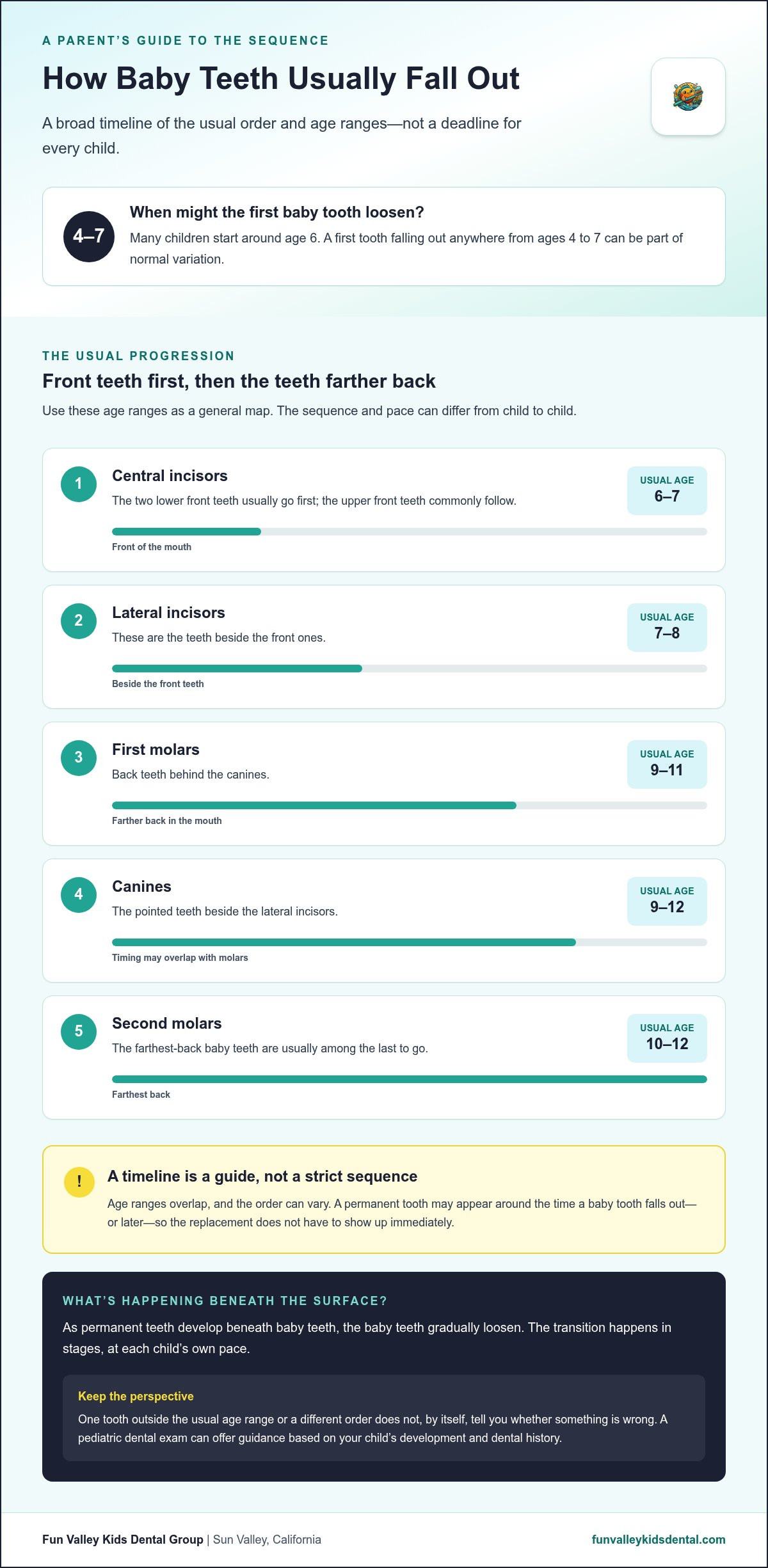
Many children begin losing baby teeth around age six. If you’re asking when do kids start losing teeth, a helpful general range is between ages 4 and 7, with age six near the middle. That range is a guide, not a deadline or a diagnosis. A child who hasn’t lost a tooth on the same schedule as a sibling or classmate isn’t automatically behind.
Baby teeth, also called primary teeth, make room over time for permanent teeth. As permanent teeth develop beneath them, the roots of baby teeth gradually change and the teeth may loosen. The transition happens in stages, so the first wiggly tooth is one small landmark in a longer journey. The overview of deciduous teeth also describes how primary teeth are replaced by permanent ones.
Most children lose their first baby tooth around age six, though a first tooth falling out between ages 4 and 7 can be part of normal variation.
Why does a child's first loose tooth often appear around age six?
Permanent teeth develop under the primary teeth, and as they grow, the baby teeth above them can loosen and eventually fall out. This natural handoff often begins around age six, commonly with a front tooth, but there isn’t a precise switch that happens on every child’s birthday. One child may notice a wiggly tooth earlier, while another’s first one stays firm longer. Both experiences can fit a healthy variation in timing.
The age range describes a common pattern across children, not a prediction for one child. Dental development unfolds at its own pace, and the first loose tooth doesn’t tell the whole story about how the rest will go. Think of it as a trail with familiar landmarks, but not an identical route for every young explorer.
Does every child start losing teeth at the same age?
No. The first loose tooth can appear at different ages, even among children in the same family. Comparing your child with a brother, sister, or classmate may create worry without offering a reliable measure of dental development. The timing can also make more sense when considered alongside when your child’s baby teeth first came in and their dental history.
Notice the broader pattern rather than treating one tooth as a pass-or-fail milestone. For example, a child whose teeth emerged later may also lose them on a different schedule from a friend whose baby teeth appeared earlier. If you’re unsure how your child’s timeline fits their own history, a pediatric dental exam can provide individualized guidance. Fun Valley Kids Dental Group provides pediatric dental exams at its office in Sun Valley, California, where the team can assess dental development and discuss your concerns without assuming every variation needs treatment.
Baby teeth timeline: which teeth usually fall out first?
Baby teeth tend to loosen in a familiar order, starting at the front and moving toward the back. If you’re tracking when do kids start losing teeth, the sequence can offer useful context, but it isn’t a strict timetable. Two teeth in the same group may fall out at different times, and children don’t all follow the pattern at the same pace.
Which front teeth are usually first to fall out?
The two lower front teeth, called the lower central incisors, are usually first. The upper central incisors commonly follow. These familiar gaps often mark the beginning of the transition, but the order isn’t a rule that every child’s teeth must follow exactly. Delta Dental’s Baby Teeth Timeline provides approximate shedding ages for each group.
Here’s a general guide to when baby teeth may fall out:
Central incisors: The lower and upper front teeth, usually around ages 6 to 7.
Lateral incisors: The teeth beside the front ones, often around ages 7 to 8.
First molars: The back teeth behind the canines, commonly around ages 9 to 11.
Canines: The pointed teeth beside the lateral incisors, often around ages 9 to 12.
Second molars: The farthest-back baby teeth, usually around ages 10 to 12.
These ranges overlap, so use the list as a broad map rather than a tooth-by-tooth forecast. One child’s canines may loosen before their first molars, while another’s may follow a different order. A single tooth outside the listed range doesn’t, by itself, tell you whether anything is wrong.
What tends to happen after the front teeth?
After the front teeth, the remaining groups generally loosen over the next several years. Canines and molars tend to be lost later than the central incisors, with the precise order and timing varying from child to child. The change from baby teeth to permanent teeth unfolds gradually, not in one burst.
It also helps to separate a baby tooth falling out from its replacement coming in. A permanent tooth may appear around the time a baby tooth is lost, or later. The two events don’t have to happen at the same moment, so a gap without a visible replacement tooth right away can be part of the transition.
If you’d like a clearer picture of your child’s development, a pediatric dental exam can help put the pattern in context. Fun Valley Kids Dental Group provides pediatric dental exams at its office in Sun Valley, California. You can learn about pediatric dental exams and the care available for children.
Early or late tooth loss: what variation may mean
A tooth that doesn’t match the usual pattern can catch a parent’s attention, but timing alone rarely tells the whole story. A baby tooth may come out early after an injury or because decay has affected it. A tooth that seems slow to loosen may simply be following a different developmental pace. The useful question isn’t only “When do kids start losing teeth?” It’s what’s happening with this particular tooth and your child’s overall dental development.
Timing, cause, symptoms, and your child’s dental history all matter together when deciding whether a tooth needs a closer look. A delayed-looking sequence by itself can’t establish that there’s a dental problem, and every variation doesn’t call for treatment.
When should parents discuss early tooth loss with a dentist?
Ask for dental guidance if a baby tooth is lost well before you’d expect it to loosen naturally, especially after a fall or bump, or if decay may have played a role. Share when the tooth came out and whether your child has pain, swelling, or other changes. That context helps the dental team decide what to assess; it doesn’t automatically mean a particular treatment will be needed.
If a tooth comes out after an injury, an evaluation can help assess the area and the developing teeth nearby. A dentist can also consider whether the space left by an early loss needs attention as other teeth grow. The next step depends on the individual examination, not just on the fact that a baby tooth is missing.
What if a baby tooth seems late to loosen?
Look at the overall pattern rather than judging one tooth on its own. Consider which teeth have already come out, whether permanent teeth are appearing, and how your child’s teeth developed before now. Families don’t need to match a sibling’s timeline tooth for tooth. If one tooth remains firm or the sequence continues to concern you, bring it up at a pediatric dental exam.
A permanent tooth appearing before its baby tooth has fallen out is another reason to ask for individualized guidance. It may look surprising, but appearance alone can’t show what’s happening beneath the gums or whether the baby tooth needs attention. A pediatric dentist can examine the teeth and consider your child’s age, dental development, and history before advising you.
To make the conversation useful, note:
Which tooth loosened or came out, and when.
Whether there was an injury, visible decay, pain, or swelling.
Whether a permanent tooth has appeared nearby and how the other baby teeth are progressing.
At Fun Valley Kids Dental Group’s office in Sun Valley, California, a pediatric dental exam can give parents individualized guidance about a child’s tooth development. The practice serves families in Sun Valley and nearby Pacoima, Arleta, Panorama City, North Hollywood, Burbank, and Sylmar. The goal is to understand the pattern and your concerns, not to assume that every early or late tooth needs treatment.
How to help when your child's tooth becomes loose
A wiggly tooth can feel like a big expedition for a child, but your response can keep the moment calm and comfortable. Parents asking when do kids start losing teeth may also wonder whether to help a loose tooth along. In most cases, the kindest approach is simple: stay relaxed, let the tooth loosen naturally, and keep everyday mouth care gentle.
How can I make a wiggly tooth less stressful?
Let your child set the pace. You might say, “That tooth is getting ready to come out. You can leave it alone or gently wiggle it with your tongue.” Avoid pulling, teasing, or promising it will fall out by a certain day. A little patience helps your child feel in charge of this new milestone.
Keep brushing and age-appropriate flossing part of the routine. Use a soft touch around the wiggly tooth, and help your child clean the nearby teeth rather than scrubbing or tugging at the loose one. A loose baby tooth doesn’t mean the rest of the mouth should be skipped. For broader home-care habits, families can refer to a guide to preventing cavities in children.
Try these gentle steps:
Let your child decide whether to wiggle the tooth with their tongue or leave it alone.
Brush carefully around the tooth and continue cleaning the rest of the mouth.
Don’t force a tooth that isn’t ready to come out. Pulling can cause pain or hurt the surrounding area.
If the tooth comes out and there’s minor bleeding, place a clean, cold, damp washcloth over the spot with gentle pressure.
Some children are excited by the gap; others feel unsure. Follow their lead, answer questions simply, and give them room to feel however they feel. There’s no need to turn the tooth into a race or a test of bravery.
What should parents do if the tooth hurts or is injured?
Ordinary looseness may feel strange, but a tooth that becomes loose after a fall or hit, or comes with pain or swelling, deserves attention. Contact a dental professional promptly and explain what happened, when it occurred, and what symptoms you’ve noticed. Don’t try to reposition or pull a tooth after an injury. A dental evaluation can help determine what care is appropriate for your child.
If the situation feels urgent, use the practice’s children’s dental emergency guidance and seek timely professional advice. Fun Valley Kids Dental Group provides pediatric dental care at its office in Sun Valley, California. If you’re concerned about a loose, painful, or injured tooth, find information about pediatric dental care.
When to ask a pediatric dentist about tooth loss in Sun Valley
A pediatric dental exam can help you understand how your child’s teeth are developing and talk through a concern that feels hard to judge at home. The usual timeline offers a helpful reference, but it can’t account for every child’s dental history or explain why a particular tooth is loose, missing, or slow to change. If you’re still wondering when do kids start losing teeth, an individual evaluation can put the general age ranges into context for your child.
A visit doesn’t mean that a variation automatically needs treatment. The dental team can review your child’s tooth sequence, look at their oral health, and consider details such as an earlier injury or a tooth that seems to be taking a different path. Any recommendations depend on the examination and your child’s clinical needs. Sometimes the visit simply gives you a clearer understanding of what to watch for.
What can a pediatric dental visit clarify?
A pediatric dentist can consider which teeth have come out, which are loose, and how your child’s permanent teeth are appearing. Sharing relevant dental history helps the dentist understand the broader picture rather than judging one tooth alone. A visit can also give you a chance to ask what changes to expect next. For a closer look at what happens during an appointment, see the guide to pediatric dental exams in Sun Valley.
Evaluation is tailored to the child. A dentist may recommend observation, provide guidance about home care, or discuss another next step if the exam suggests one is appropriate. No single tooth-loss pattern determines the plan for every child.
How can parents take the next step?
Before an appointment, jot down what you’ve noticed. When did the tooth first feel loose? Did it come out on its own or after an accident? Has your child had pain or swelling, or does a permanent tooth appear to be coming in nearby? These details help you explain the concern clearly. You don’t need to work out the cause before you call.
At Fun Valley Kids Dental Group’s office in Sun Valley, California, Dr. Mel provides pediatric dental care and can help assess your child’s development during an exam. The goal is to understand your child’s needs and answer your questions, not to assume every difference needs treatment. If you’d like personalized guidance, contact Fun Valley Kids Dental Group to schedule a pediatric dental appointment. A calm conversation and a careful look can help your family feel more at ease about the next step in your child’s growing-up journey.
Make your child’s next dental milestone feel easier
A new dental milestone can bring questions, even when everything seems to be moving along. Keep a note of anything you’d like to ask, such as how your child is feeling about a wiggly tooth or what changes to watch for next. Dr. Mel has more than 20 years of experience caring for children and can help you talk through your concerns during an appointment.
If you’d like individualized guidance for your child, schedule a pediatric dental appointment with Fun Valley Kids Dental Group. Each child’s growing-up journey is their own, and a thoughtful conversation can help your family approach the next milestone with confidence and comfort.
Frequently Asked Questions
When do kids usually lose their first tooth?
Most children lose their first baby tooth around age six, though the broader usual range is ages 4 to 7. If you’re tracking when do kids start losing teeth, jot down the date and which tooth came out. That simple note can help you describe your child’s pattern at a routine dental visit, especially if other teeth seem to be changing at a different pace.
Which baby teeth do children usually lose first?
The lower front teeth, followed by the upper front teeth, are usually the first to go. If you’re unsure which tooth you’re looking at, compare it with the matching tooth on the other side and note its position. Keeping track of the location can make it easier to describe the sequence to your child’s dentist without needing to know dental terminology.
Is it normal for a child to lose a baby tooth before age six?
Yes. Losing a tooth before six can fall within the usual age range, since some children begin around age four. Pay attention to how it happened: a tooth that came out after a fall or appears affected by decay is worth discussing with a dentist. A brief note about the event and any discomfort can help guide that conversation.
Can a permanent tooth come in before a baby tooth falls out?
Yes, it can happen. If you notice a new tooth while the baby tooth is still present, take note of where it’s emerging and whether the baby tooth moves comfortably. Avoid probing the area or trying to shift either tooth. A clear description, or a photo taken without touching the teeth, may help you explain what you’ve noticed during a dental visit.
Should I pull my child's loose baby tooth?
It’s generally best to leave a loose tooth alone until it comes out easily. Let your child decide whether to gently move it with their tongue, and stop if that causes discomfort. Keep normal brushing going with a light touch nearby. Avoid using string, tools, or force to hurry the process, since a tooth that isn’t ready may still be attached.
What happens if a child loses a baby tooth because of an injury?
After an injury, contact a dental professional and describe how the tooth was affected. Note whether it was knocked out, chipped, or loosened, and whether your child has pain or swelling. If there’s bleeding, gentle pressure with a clean cloth can help. Keep any details about the accident handy so the dental team can understand the situation and advise you.
When should I take my child to a dentist for a loose tooth?
Arrange an evaluation if looseness follows an accident, or if your child has pain, swelling, or another change that concerns you. You can also bring up a tooth that seems out of step with the rest during a pediatric dental exam. Before the visit, note when you first noticed the change and whether it has become more or less uncomfortable. For individualized guidance, contact Fun Valley Kids Dental Group in Sun Valley, California to schedule a pediatric dental appointment.


Comments